Wednesday, February 2, 2022

Thin-Slicing Hits the Spot!

While I sit here on this beautiful snow day,
I have time to reflect on yesterday's lesson.
It was based around another form of thin slicing.
Students worked at boards to demonstrate understanding of all the representations:
Story in words, 
Graph,
Table,
and Equation
for new car situations.

Each problem described the situation with just one of the representations.

As students progressed through the problems,
(I started with the story in words, then gave out a problem with just the table, 
before allowing them to tackle a problem from just the equation),
I was able to hone in on specific items for each group, such as
--> drawing precise graphs
--> using the table to check your graph
--> making sure direction of the graph is included in the equation

To begin work on fluency,
we traded out the car situations for savings account situations,
before going strictly to the most abstract,
naked numbers with no story attached.

What I heard when I introduced just the naked number problems,
Was students tying it back to a car situation or savings account.
They were adding the story to it to attach it to their original learning!  

Making math accessible is something I strive for every day.
To help do this, visualization is essential.
And yesterday's thin-slicing lesson had it in spades!  :)


Monday, January 31, 2022

Consolidation Thoughts

Whole group discussions, or consolidation, have always been in the top three learning activities for my students.
Today, we combined consolidation with a thin-slicing activity!  
More bang for the buck was my hope!  :)

Background
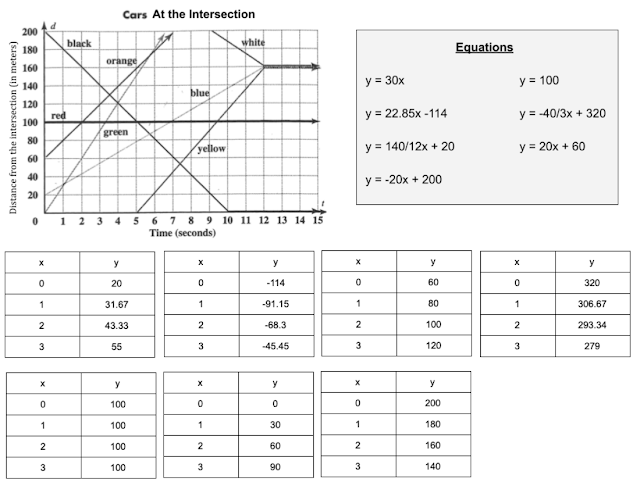
For the last two weeks, we've been analyzing and communicating about the following graph.  

Students started out by just pulling information from the graph and completing the chart below.
After consolidation on various aspects of the graph and chart, 
We moved on to analyzing how the story can be represented in multiple ways.
In a story with words.
In a graph.
In a table.
And the most abstract of all, in an equation.
Students had worked a little bit with tables previous to this,
And quickly caught on to which table matched each car's story.
This was the first time for equations to enter the picture as a way to communicate the story.
Because I only offered seven choices, students were able to connect the correct equation to each story.
(To ramp up the rigor, I could provide good distractors to the list.
This however, was not my goal for the lesson.
The goal for the lesson was for students to identify all pieces of the story (speed, starting point and direction) before I connect these concepts to their more abstract mathematical vocabulary (slope, y-intercept, and positive/negative slope).
Today, we looked at where the main pieces (speed, starting point, and direction)
Are found in each representation.
Highlighting each with a different shape and color.

After analyzing each format of the story,
Students worked in their groups (at their desks to avoid transfer time to the white boards)
And created equations or tables for various scenarios.
1) Create an equation for a car moving faster than the green car.
2) Write an equation for a car starting closer to the intersection than the orange car.
3) Create a table for a moving at 25 m/s


4) Create a table for a car starting 10 m from the intersection, moving at 35 m/s.
5) Write an equation for a car going in the opposite direction as the black car.

Since we weren't at the vertical white boards,
Students simply held up their individual board at each table
So everyone could see their work
And a mini conversation could be had over misconceptions or differences in the equations.

The thin-slicing of questions started off easy with a focus on the starting point,
Before moving on to speed,
Then direction,
Then combinations of the two or all three!

I love how these strategies can lend themselves into various outlets in the classroom.
While we all see the benefits of the vertical white boards,
The same concept can be implemented at tables to help save some class time.

Thursday, January 6, 2022

The Importance of Note-Taking For Learning

For our last quiz before break,
I did something I've never done before.  
I allowed my students to use their notes.
We had been learning about angles,
And I had had to cram the entire unit into three weeks
Instead of 4 (or maybe 5).
I felt this was only fair to my students
If they were allowed to use notes.

So when the last 15 minutes rolled around,
I announced that they could take out their notebooks to finish their quizzes.
Many had already completed their quiz by this time.
I saw them scan through their quiz,
And then they handed it to me as is.
No review of the notes.
They must have felt confident with what they had.

I made notations on who used notes and who didn't. 
I was curious.

After calculating the averages for both groups,
I was even more curious,
As the results blew me away.
It was NOT what I was expecting!


Students who passed on the opportunity to use notes scored an average of 74%
While students who used their notes scored only a 61% average.
Interesting.

You see, we totally changed how we take notes this year.
I no longer have note-taking days where I lead the process on the document camera.
Note-taking has taken on a totally new look.

Note-Taking Strategy 1
Students grab their notebooks whenever they like to take notes. 
I don't suggest it while we are actively learning.
I do refer to it anytime note-taking is highlighted as a good learning strategy.
But I don't require it.
I want the students to see the value for themselves.
To own their learning.

Note-Taking Strategy 2
Notes for my future forgetful self.
This strategy is usually done at the end of the unit.
Students make notations under headings that I give them over what they've learned.
After they have individually written down their reflections of what they don't want to forget,
We bring it together as a whole class discussion
Where students can share outloud what they included in their own notes.
(which adds another exposure to the material for my struggling students)!
I then write these items on the board as a model of the process.

Note-Take Strategy 3
Getting information from a video source.
EdPuzzle is my best friend of the pandemic.
I love the videos, making videos, and including interactive questions to aid in the learning process.
This way, I am assured that all students have watched the video
And have interacted with the new material in some way with the questions I embed into the lesson.
Again, students are encouraged to take notes on what they learn.
We talk about how to do this.
If they have a moment where their brain says, "Oh!  That makes sense!"
That's a flag to write it down!
If their brain is like, "Oh!  I never knew that!"
Another indicator to get it down!


So, I shared the information with my students.
Wondering what their thought processes were for why this happened.
The reasons for the students that USED the notes on the quiz:
1) Their notes were not complete so weren't much of a help anyway
2) They didn't even take notes

Reason for the students that DID NOT use their notes:
1) They already knew the material

This just validates Marzano's findings with notetaking being the 2nd best Instructional Strategy for increasing student achievement.

And as the students reported earlier why they felt note-taking helped them learn better,

I think maybe, just maybe,
We might be doing something right this year.  :)


Monday, December 27, 2021

Grades this Semester

I finalized grades today for the semester.
I only had one failing grade.
One.
This has never happened.
So, this has me wondering,
Is it the No Grades on classwork policy that I've adopted this year????
Is there actually more learning happening because I've removed the need just to get it done?
Or is this just a more accurate reflection of the learning and not so much of homework completion, responsibility, and work ethic???

Something to ponder?

Wednesday, December 15, 2021

Moving to the Floor


It's not a vertical white board,
But students actively participated in finding all the angle relationships on the floor.
Moving and thinking provides even greater learning!  
Plus, misconceptions and mistakes can be used to launch much needed discussion.
Marzano's strategy of similarities and differences was used
As we compared the various angles.


Tuesday, December 14, 2021

Student Reasons for Their Choice in Learning Activity

Vertical White Boards (Marzano's Practice, BTC Ch. 3)
  • Helps me work with others

  • It helps me

  • We can visually show how we learn

  • Talking with someone and adding me and the person’s brain to see what we understand 

  • Helps me see it in front of me

  • Get to talk to other people and see what they are doing

  • It helps me like the notetaking that follows

  • We have partners to work with and show us our mistakes

  • I can use my partner’s knowledge to understand it better


Note-Taking (Marzano's Practice, BTC Ch. 11)
  • Video note-taking helps me remember

  • I can go back to it and study

  • I can go back and look at it

  • Helps me study whenever

  • It keeps me focused and when I forget something I can look at them.

  • Writing it down helps me learn it

  • Helps me remember better

  • Writing things down helps me remember better & easier to study

  • If I forget something i can look back into my notes

  • You can look at it at home and study for the quiz

  • So I can go over it whenever!


Whole Group Discussions (BTC Ch. 10)
  • I can see what others have to say, plus what they are questioning

  • Everyone gets a chance to say what they think.

  • Everyone gets to answer and you can hear other people’s thoughts


Check Your Understanding (Marzano's Practice)
  • If I get it wrong and look at the answer key I can see where and how I messed up and retry to understand it and get better

  • Helps me with studying

  • So I can see how much I know

  • You can do your work, check your answer and see your mistake

  • When I check it on my own, I get a better understanding


No Grades (BTC Ch. 14)
  • A lot less stress and if you get it you don’t have to do the rest

  • If I don’t finish it, it won’t bring my grade down

  • I don’t have to worry about making mistakes

  • It keeps my grade up

  • I don’t stress as much

  • It lets us make mistakes without having a consequence


Making Mistakes
  • Helps me learn and not to do it wrong again

  • Helps me see what I did so I can learn from it

  • So I can go back and learn better

  • When I make mistakes I feel like I learn it and figure it out more easier because a teacher or someone else will explain it to me better and I will understand it. 

  • You learn from your mistakes

Thursday, December 9, 2021

From the Students' Perspective

I was curious.
What learning activity from BTC did the students find most beneficial?

At the end of their quiz today, 
I posted the following six strategies for them to choose one.

1) Working at the vertical white boards
2) Whole Group Discussions (Consolidating)
3) No Grades on Classwork
4) Note Taking for my Future Forgetful Self
5) Check Your Understanding
6) Making Mistakes


I had thought the boards would be in the majority.
Last time I asked, 67% of the students viewed working at the boards as the most beneficial. 
Discussions came in second when I asked the first time.
I was surprised to see that Note Taking had such high marks.
Are students really seeing the value of note taking?
Are they using these notes to study from?
What are their reasons for rating this one so high?

I guess I have more investigating to do!  :)